Fine Turgrass Management

Fine Turgrass Management

Steve Cook, CGCS, MG - Director of Agronomy

Showing posts with label Trees. Show all posts

Thursday, August 28, 2014

Storm Damage

We came through the recent storm in pretty good shape. We lost two trees on the South: an American Beech left of #15 fairway and a Shagbark Hickory on #16. These were two native trees, here when the course was built, so that's unfortunate. All other damage was minor and will be cleaned up by next week.


#16 -  1922


Shagbark Hickory #16 South

American Beech #15

American Beech #15

Monday, May 27, 2013

Tree Planting North Course

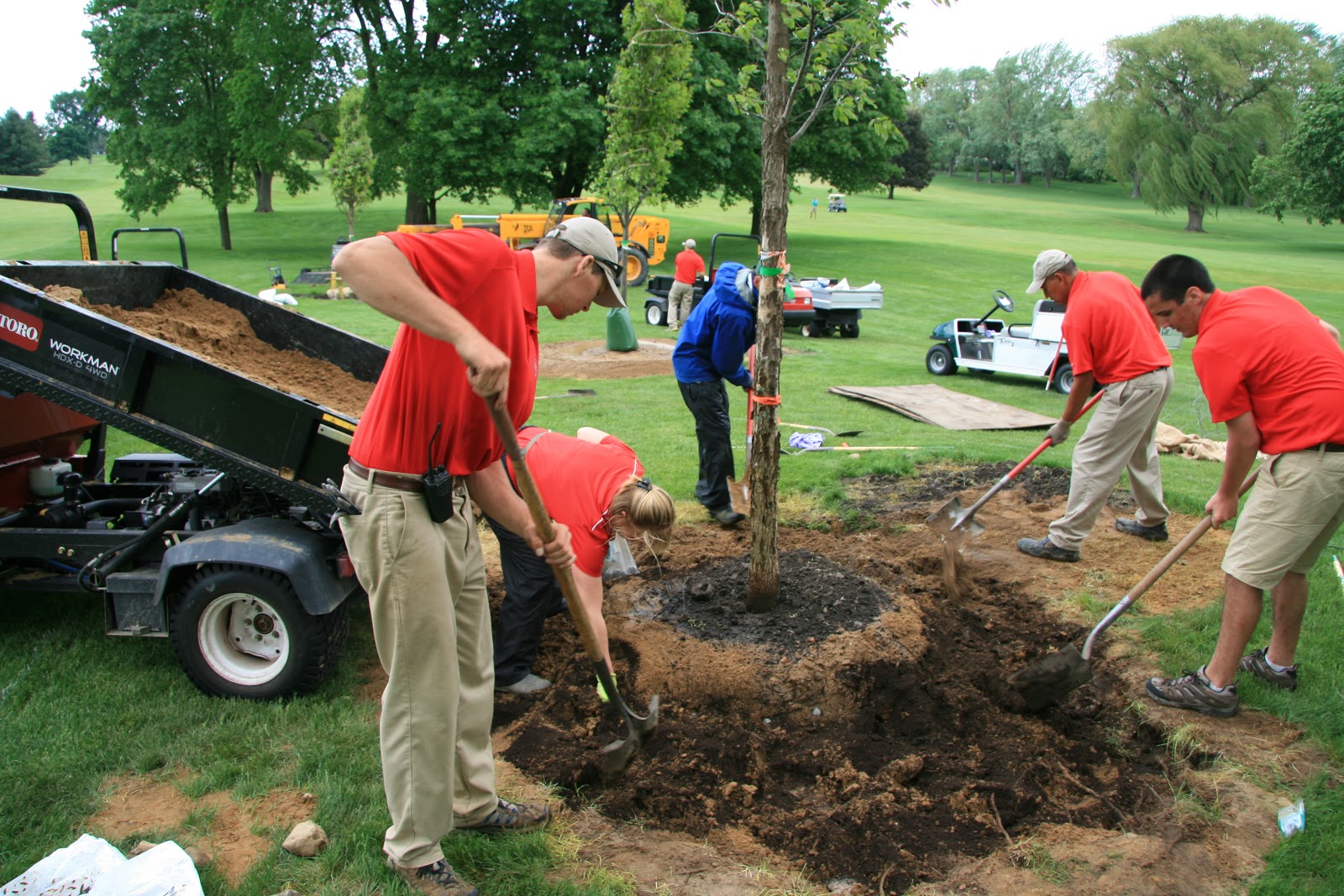
As part of the North Course renovation project we installed 18 Oak trees on the North Course last week. The species of Oak trees we use are native to SE Michigan and Oakland County: White Oak, Bur Oak, Red Oak, Swamp White Oak and Chinkapin Oak. We also added a Kentucky Coffee tree -  native to SE MI - to the bottom of hole number one.

A total of 121 trees will be removed and approximately 70 trees added as part of the renovation. A net loss of 50 trees is less than 10% of the total tree inventory.


Planting trees should be carefully considered. It costs $1,000 to plant a tree: cost of the tree, transportation, labor, materials, rental equipment etc. Yet this is just a down payment. Like a mortgage, we will spend 10 times this amount over the course of a trees' life in added maintenance cost: pruning, mulching, leaf cleanup, weak turf ... and eventual removal. By planting 70 trees we have added an additional $700,000 in long-term costs!

There are very few original, native trees on either golf course. Most of the trees you see are "man-planted", not native and many are considered "invasive" species by the Michigan DNR. Invasive species like Silver Maples (think helicopters) add maintenance costs as they require constant pruning and their roots and leaves weaken surrounding turf.


Friday, March 1, 2013

Winter Pruning

Oak Wilt is a vascular disease and it attacks all Oaks. The disease plugs the water conducting (or sapwood) tissue, interrupting the flow of water, leading to wilting and sometimes death. Fungicides can be injected to protect the tree, but as with any chemical treatment, the results can be inconsistent.

An easy way to prevent Oak Wilt is to prune outside of the disease transmittal time frame. Sap feeding beetles can spread the fungus from tree to tree, so it is important to avoid open pruning wounds during the growing season when beetles are in flight. So winter pruning on oaks is preferred.

This week we begin our annual schedule of oak pruning on both courses. It takes about one week to complete those trees scheduled: 10 - 20% of the native oak inventory.


Tuesday, January 29, 2013

Tree Removal Update

The following trees are next on the list for removal. All are related to the North Course renovation:

- Willow 16 tee
 - Oak 16 tee
- Group of maples between 15/16 for new pond
- Silver maple 14 green
- Spruce left of 12 tee
- Apple right of 6 tee

Obviously, with the weather this week we are in a delay until the ground firms up, perhaps until next week.

Wednesday, December 19, 2012

Tree Removals

We began the approved tree removals on the North Course this week. Four Cottonwoods adjacent to number six green were felled yesterday. They were removed for the following reasons:

1. root and shade encroachment on six green
2. interference with the new back tee on number seven
3. interference with the pond enlargement
4. aesthetic and playability issues

The architect, Green Committee, Board and me all agreed that the these four trees should come down. We'll have healthier turf and a more playable hole when we're finished.  There are no plans to replace them.


Tuesday, December 11, 2012

North Course Tree Removals

In conjunction with the North Course renovation next year, several trees have been approved for removal. Most of these are to make room for the new back tee additions. Because winter is a perfect time for this work (firm, hard ground conditions limit damage from equipment) we are strarting this week with some of the removals.

Willows #5 tee

Friday, November 9, 2012

Early Leaf Drop?

It seems to many people that trees have dropped their leaves earlier this year and that fall color came sooner than expected.

This may be due to the drought this summer and dry conditions this fall. Trees under drought stress typically develop fall coloration earlier. It is wise, even this late in the year to water "evergreen" trees like White pine, Spruce and arborvitae. This type of plant material - particularly newly installed - will need moisture throughout the winter. Mulching any new plant material can help alleviate dessication in winter.

Friday, October 19, 2012

Donald Ross on Trees


"As beautiful as trees are, and as fond as you and I are of them, we still must not lose sight of the fact that there is a limited place for them in golf. We must not allow our sentiments to crowd out the real intent of a golf course, that of providing fair playing conditions. If it in any way interferes with a properly played stroke, I think the tree is an unfair hazard and should not be allowed to stand."


- Donald Ross, from Golf Has Never Failed Me


Monday, August 20, 2012

Silver Maple 12 Green South

As I reported 2 weeks ago, the Silver Maple between 12 green and 13 tee is being removed today. It was damaged in a storm and deemed a safety hazard as it is so close to play. In addition, once removed it will provide morning sunlight on #12 green.


Monday, August 13, 2012

Fescue/Tree Removal #6


The dead and dying Austrian pines between #6 green and #5 fairway are being removed today and tomorrow. This area will be seeded to fescue (like #3 and #14) next week. It will take 3-5 years for this area to fully mature.

Saturday, July 28, 2012

Silver Maple (WTGH) 12 Green

The Silver Maple (WTGH) between 12 green and 13 tee South Course lost a large limb on Thursday. There was a cavity inside that compromised the structure of the limb and it simply fell off. As the tree is past maturity and it poses a serious safety hazard, we are recommending it's removal. The USGA and our course architect concur,  it should be removed. We are asking our arborist to do one final inspection on Monday to be certain, but as of now removal is scheduled for Tuesday morning.


Tuesday, July 17, 2012

Oak Tree #15 South

A dead White Oak on the right side of #15 fairway South was removed yesterday. It declined quickly over the past two months and our suspicion is that it was a mature tree that finally succumbed to the heat and drought stress. It had been the victim of storm damage in prior years and had been heavily pruned after those occasions.

There is a small chance that it was infected with Oak Wilt, a contagious desease of the Red Oak family not typically found on White Oaks. But in the interest of the safety of the surounding trees, we are shipping a sample to the University of Minnesota where they are experts at identifying Oak Wilt.

Saturday, July 7, 2012

Storm Damage

During the last storm we lost a total of 13 trees. None were critical to play. Unfortunately, one of those trees was a large Oak to the right of #18 fairway estimated to be more than 130 years old. Although not in play, it was native to the property. The others were Spruce, Willow, Linden and an old apple tree. The cleanup will be completed this week.

Saturday, May 12, 2012

Weeds That Got Hard: The REAL Cost

When planting a tree like a Silver Maple (weed that will get hard) it's important to consider its true cost. Assume that a high quality, 4"-6" DBH tree will cost $1,000 to install. Over the course of its life span you can count on spending 10 times that amount in maintenance costs, including its eventual removal.

The obvious costs of routine care - fertilizer, pest treatments, pruning, leaf cleanup, mulching etc - are easy to identify. The hidden costs are more difficult. Consider the cost of maintaining weak turfgrass that has to compete with a tree for water and nutrients. The cost of shade on playing surfaces that require more inputs because the lack of sunlight leads to weaker turf.

And then consider these aggravating photos below. Not only do these weeds that got hard (WTGH) cause an endless supply of turfgrass issues, they compound the problem by shedding their seeds all over putting greens each spring. This requires us to schedule extra labor to clear the putting surfaces so they can be cut and/or rolled. And it requires us to blow and rake the seeds from bunkers so they can be raked and prepared for play.

Little value can be attached to planting weeds that will eventually get hard.


Seeds on a weed that got hard

Seeds removed from a bunker


Extra labor to remove seeds from putting greens


Monday, April 16, 2012

Windy Day

The large Silver Maple left of #5 fairway (just over the bridge) succumbed to the high winds today. Because of it's hazardous condition, we are having it removed as quickly as possible. Silver Maples are composed of week interior wood and this tree was at the limit of its life span.

Once removed, we should see an improvement in the turf at the exit to the bridge. Maples have a dense and shallow root system that make it hard for turf to compete for water. Trees like Silver Maples, should not be planted adjacent to in play areas.


Arrows show fissured trunk

Heart rot

Thursday, March 22, 2012

Tree Removal Update

Here is a list of trees removed this past winter:

South
1 Maple left of #1
1 Maple right of #1 green
2 Spruce left of #7 green
2 Maples right of #12 green
Group of Spruce/Locust left of #14
2 Maples left of #14 appr.
4 Spruce left of #10
2 Maples left of #6 green

North
3 Spruce right of #14
1 Willow right of #12 green

dead Spruce between 6/14 South


Rotted center, Maple #6 green

Wednesday, February 15, 2012

Spruce #10 South

The Spruce between #10/11 South have been removed exposing a spectacular view to #17 green in the distance. You are beginning to see the golf course as designed in 1920. The photo below is a little grainy due to snow, but #17 green is still visible.

Double click for an enlarged view.

Monday, February 13, 2012

Pruning New Oak Trees

The Oak trees we have planted over the past 5 years are in need of attention. We typically wait a few year after installation before pruning so the trees can become established. Most or all of the branching structure you see on these Oaks will not be there at maturity, so our objective in pruning is to establish a strong central leader and eliminate poor structure.

We prune in the winter to avoid the spread of Oak Wilt disease. The disease has been found in 21 States, with considerable damage occurring in the Midwest including southern to mid-Michigan. It was first recognized as an important disease in 1944 in Wisconsin. The fungus is spread by beetles and the main period of infection is in the spring, so pruning in the winter is critical.


Julie Stacheski from Site Specific

Monday, February 6, 2012

List of Trees for Removal Winter 2012

The following is a list of all the planned tree removals this year. Our plan is to do these removals this winter if the ground freezes. If not, we'll wait until the summer when the ground is firm. Most of these removals are consistent with our Master Plan, were recommended by the Golf Course Architect, approved by the Green Committee and Board of Directors or are dead, diseased or dying:

South Course
1 Maple left of #1 fairway - playability and aesthetics
1 Maple back right of #1 green - turf conditions, winter sun
1 Maple left of #6 green - prior scheduled, removal, poor condition, playability, aesthetics
1 Maple left of #6 bunker - poor condition, safety, dying
2 Spruce left of #7 green - playability, aesthetics
4 Spruce left of #10 frwy. - aesthetics, traffic control
2 Maples right of #12 green - traffic, turf conditions, aesthetics
Group of Pine/Spruce/Locust/Maple between #6/#14 - aesthetics, poor condition


North Course
1 Willow #12 pond - dead
1 Oak #13 - dead
3 Spruce #14 approach - diseased, dying, traffic control
1 Poplar behind #11 green - dying, pruning cost exceeds removal cost
1 Maple #11 green - traffic control

Wednesday, February 1, 2012

Tree Removal Update

The following trees have been removed as approved by the Golf Course Architect, Green Committee and Board of Directors:

2 Spruce #7 green South
2 Maples hole #1 South
2 Maples #12 green South

The remaining tree scheduled for removal are on hold until the ground conditions allow access.